Detect ChatGPT Content Online — How to Identify AI Written Text Accurately
Detect ChatGPT Content Online — How to Identify AI Written Text Accurately
ChatGPT writing analysis
ChatGPT crossed 100 million users faster than any technology in history. Today it is used by students, writers, marketers, developers, and businesses worldwide to generate text at a scale that was impossible just a few years ago.
This has created a serious problem for anyone who depends on authentic, human-written content — teachers grading essays, editors reviewing submissions, employers reading cover letters, and publishers maintaining content standards.
The solution is straightforward: detect ChatGPT content online using a reliable, free tool before making any decisions about the text in front of you.
ChatGPT and other large language models generate text through a process called next-token prediction. At each step, the model selects the most statistically probable next word based on the context that came before it.
This process produces text that is grammatically correct and often coherent — but statistically predictable in ways that differ measurably from human writing.
Perplexity — The Core Detection Signal
Perplexity measures how surprised a language model is by a given piece of text. Human writing tends to be more surprising — we use unexpected metaphors, unusual word choices, and personal phrasing that deviates from statistical norms.
ChatGPT content has low perplexity — meaning it follows predictable patterns that AI detection tools are trained to recognize.
Burstiness — The Rhythm of Writing
Burstiness measures variation in sentence length throughout a piece of text. Human writers naturally alternate between short, punchy sentences and longer, more complex ones.
ChatGPT tends to produce paragraphs where every sentence is roughly the same length — a low-burstiness signature that detection tools flag reliably.
Uniform Vocabulary Distribution
Human writers overuse certain words they love, underuse others they dislike, and have personal quirks in phrasing. ChatGPT distributes vocabulary with statistical uniformity that feels smooth on the surface but lacks the individual voice of a real person.
Before using a detection tool, you can often spot ChatGPT content through careful reading. Look for these patterns:
Telltale Phrases
ChatGPT has habitual phrase patterns that appear across millions of outputs:
– “In today’s fast-paced world”
– “It is important to note that”
– “Furthermore” and “Moreover” used repeatedly
– “In conclusion, it is clear that”
– “This is a testament to”
– “Navigating the complexities of”
– “Delve into”
– “Robust” used to describe almost anything
If you spot three or more of these phrases in a short piece, there is a high likelihood ChatGPT was involved.
Absence of Personal Experience
ChatGPT cannot draw on real personal experience. It produces generalized statements that could apply to anyone, but lacks the specific “I was in this exact situation” detail that genuine human writing contains naturally.
Perfect Grammar With No Personality
Ironically, content that is grammatically flawless but reads as completely generic is a red flag. Real writers make deliberate stylistic choices — including breaking grammar rules occasionally for effect. ChatGPT defaults to grammatically safe, neutral language.
Overly Balanced Structure
ChatGPT loves producing content with perfectly balanced sections — every heading has exactly three bullet points, every argument gets exactly two supporting examples, every paragraph is exactly four sentences. Human writing is messier and more organic.
How to Detect ChatGPT Content Online — Step by Step
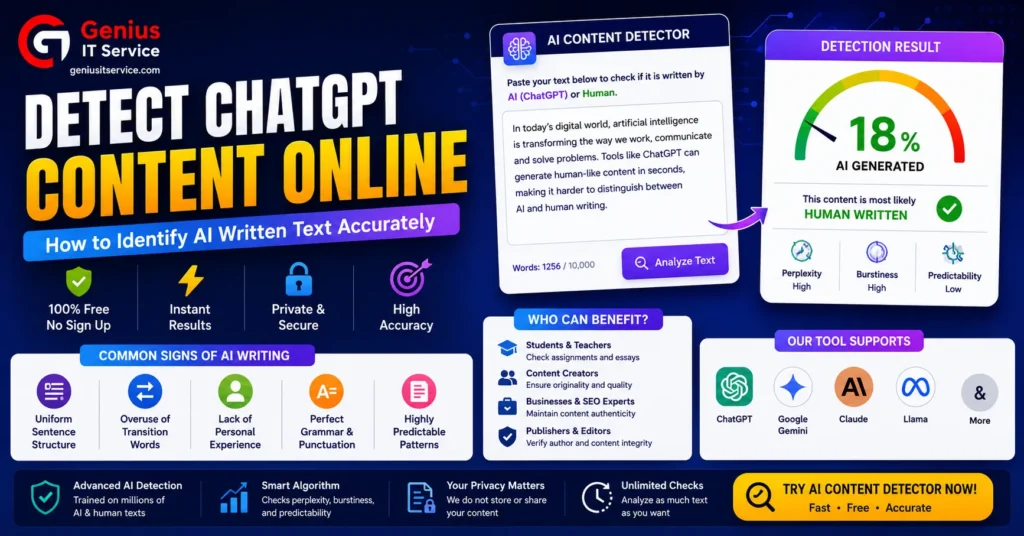
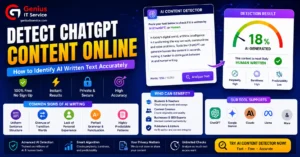
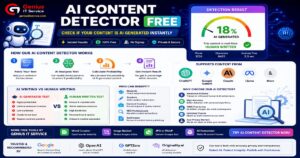
Open our free AI Content Detector at geniusitservice.com. provides fast, reliable detection for ChatGPT and other AI models.
Step 1 — Copy the Suspicious Text Select and copy the text you want to check. For best accuracy, use at least 150 words. Shorter samples produce less reliable results.
Step 2 — Open the Detection Tool Visit our free AI Content Detector at geniusitservice.com. No account or payment required.
Step 3 — Paste and Analyze Paste the copied text into the input field and click the Analyze button. The tool processes the text and returns results within seconds.
Step 4 — Interpret Your Score The tool returns an AI probability percentage:
– 0% to 20% — Very likely human written
– 21% to 50% — Mixed signals, possibly AI-assisted
– 51% to 80% — Likely AI generated
– 81% to 100% — Very likely ChatGPT or AI generated
Step 5 — Take Appropriate Action Use the score alongside your own reading of the text to make informed decisions. A score above 80% combined with the telltale phrases described above gives strong grounds to investigate further.
Where ChatGPT Detection Is Most Critical
Academic Settings
Universities and schools worldwide have updated their academic integrity policies to address AI-generated submissions. Educators use detection tools to:
– Screen essays and research papers before grading
– Identify patterns across multiple submissions from the same student
– Provide evidence for academic integrity investigations
– Educate students about proper AI use versus academic dishonesty
Content Publishing and Blogging
Search engines reward original, expert content. Publishers and blog editors use ChatGPT detection to:
– Maintain consistent content quality across large teams
– Screen guest post submissions from external contributors
– Verify that in-house content meets editorial standards
– Protect domain authority from low-quality AI content penalties
Hiring and Recruitment
Cover letters, writing samples, and assessment tasks submitted by job candidates are increasingly being screened for AI generation. Employers want to evaluate a candidate’s actual writing ability — not their ability to prompt ChatGPT.
Legal and Compliance Documents
In legal contexts, document authenticity matters. Contracts, affidavits, compliance reports, and legal briefs must reflect genuine human judgment. AI detection tools add a verification layer to document review processes.
Understanding what detection tools cannot do is just as important as knowing what they can do.
False Positives
Some human writers naturally write in a very structured, uniform style that resembles AI output. Non-native English speakers often produce text with lower burstiness and higher uniformity — which can trigger false positives.
Detection scores should never be the sole basis for accusing someone of using AI. They should be one signal among several.
Heavily Edited AI Content
When someone takes ChatGPT output and substantially rewrites it — changing sentence structure, adding personal anecdotes, removing generic phrases — detection accuracy drops significantly.
A well-humanized AI draft may score below 30% on most detectors. This is why detection tools work best as a first-pass screening rather than a definitive verdict.
New AI Models
Detection tools are trained on known AI models. As new models are released, there is a brief period where detection accuracy is lower until the tools are updated to recognize the new model’s patterns.
ChatGPT Detection vs Plagiarism Detection — Key Difference
Many people confuse AI detection with plagiarism detection. They are fundamentally different.
Plagiarism detection tools like Turnitin check whether your text matches existing content on the internet or in their database. They look for copied or closely paraphrased text.
AI detection tools check whether your text shows statistical patterns of AI generation — regardless of whether it matches any existing content. ChatGPT generates unique text every time, so it passes plagiarism checkers while still being detectable as AI.
You need both tools for complete content verification.
Its Make Some Difference
Modern AI writing checker tools use advanced AI text identification methods to analyze sentence structure, perplexity, burstiness, and writing consistency in order to determine whether content was written by a human or generated by artificial intelligence. A detailed ChatGPT writing analysis can reveal common AI patterns such as overly balanced paragraphs, predictable phrasing, and lack of personal experience. Understanding the difference between human vs AI text has become increasingly important for teachers, publishers, SEO professionals, and businesses that depend on authentic communication. Using an AI generated text detector helps verify content originality, improve writing quality, and identify whether a document reflects genuine human expertise or automated AI-assisted writing.
Genius vs GPTZero vs Originality.ai” Comparison
Tool
Free
Accuracy
Best For
Genius Tool
Yes
High
General detection
GPTZero
Limited
Medium
Education
Originality.ai
Paid
High
Publishers
To better understand how AI-generated content is created and evaluated, readers can also explore trusted resources like
Google’s Official Guidance on AI-Generated Content,
which explains how Google evaluates helpful and high-quality AI-assisted pages. The official
OpenAI ChatGPT Overview
provides insights into how large language models generate human-like text, while platforms like
GPTZero
and
Turnitin’s AI Writing Resources
discuss modern AI detection methods, academic integrity challenges, false positives, and the evolving accuracy of AI content detection systems.
Why Human Content?
“All Content Made By AI then All information may be Manupulated by AI. Human Never be Learn or Product New Content. AI can rearange the Content but not Product New Idea or fresh new things , only human can do IT”
Uniform sentence lengths, overuse of transitional phrases, absence of personal anecdotes, generic examples, and specific filler phrases like in today’s digital landscape or it is important to note.
Lightly edited content can still be detected at 70% to 85% accuracy. Heavily rewritten content becomes significantly harder to flag. The more human rewriting involved, the lower the detection score.
To maintain academic integrity and ensure students develop genuine critical thinking and writing skills rather than outsourcing their learning to an AI tool.
No. Accuracy ranges from 85% to 95% on unmodified output. False positives and negatives occur. Always use detection scores alongside other contextual evidence.
Final Thoughts
ChatGPT has changed how content is created — but it has not changed what good content looks like. Genuine expertise, personal voice, specific examples, and original thinking are still what Google rewards and what human readers respond to.
For teachers, editors, publishers, employers, and anyone who depends on authentic written content, detecting ChatGPT content online is now an essential part of the workflow.
Our free AI Content Detector at Genius IT Service gives you instant, accurate results with no account and no cost. Check any text in seconds.
Use our free tools to download, resize, and optimize your thumbnails — all at geniusitservice.com.
We are dedicated digital solutions expert specializing in SEO tools, content optimization, and web-based utilities. With practical experience in building high-performance online tools, he focuses on creating simple, fast, and user-friendly solutions for everyday digital needs.